The Blank Page Stares Back: Five Questions Paper Man Leaves for Anyone Who Makes Things

Photo by Photo by Kelly Sikkema on Unsplash on Unsplash
Paper Man is about a writer who cannot write. That alone makes it dangerous viewing for anyone who makes things. The film does not offer a tidy cure for creative block. It does not hand out a five-step plan. What it does is worse and better: it holds up a mirror and asks questions you may have been avoiding.
Call it the Paper Man test. Not a quiz with a score. Not a productivity hack. Just five questions the film leaves behind, each anchored to a moment on screen, each useful for blocked writers, stalled artists, and anyone negotiating the gap between ambition and fear. The point is not to turn the movie into a lecture. The point is to let it do what good art does: make you slightly more honest with yourself.
1. Who Are You Performing For?
Captain Excellent is the obvious anchor here. He is Richard's imaginary friend, but he is also an audience. He watches. He judges. He offers the kind of grand, superhero-sized encouragement that sounds inspiring until you realize it is also a performance. Richard is not just writing for himself. He is writing for the voice in his head that tells him what a real writer should be.
The prompt: Name the imaginary audience you keep writing for. Is it a critic, a former teacher, a rival, a version of yourself who already succeeded? Write down who you think is watching. Then ask whether that audience is helping you tell the truth or just helping you rehearse a version of yourself that looks good.
2. What Are You Calling Writer's Block?
Richard's blank page is not just a lack of ideas. It is a pile of pressure, expectation, and old identity. The film understands that what we call block is often something more specific: fear of being seen, fear of being ordinary, fear of finishing something that will not save you. The desk is not empty. It is crowded.
The prompt: Finish this sentence without using the phrase writer's block: I am not making the thing because I am afraid that ______. Be specific. Are you afraid it will be bad? Are you afraid it will be good and then you will have to keep going? Are you afraid it will reveal something about you that you would rather keep in the drawer?
3. Who Gets to See the Rough Draft?
Abby matters here because she is not a gatekeeper. She is a presence. She sees Richard in a state that is not polished, not impressive, not finished. That kind of witness is rare, and the film treats it as both a threat and a gift. Being seen before you are ready is terrifying. It is also the only way some work ever gets made.
The prompt: List one person who has earned the right to see your rough draft. Not your final draft. Not your pitch. The messy one. If no one comes to mind, that is useful information. Maybe the next creative task is not to make better work but to build one honest relationship where unfinished work can exist.
4. Where Do You Keep the Door Slightly Open?
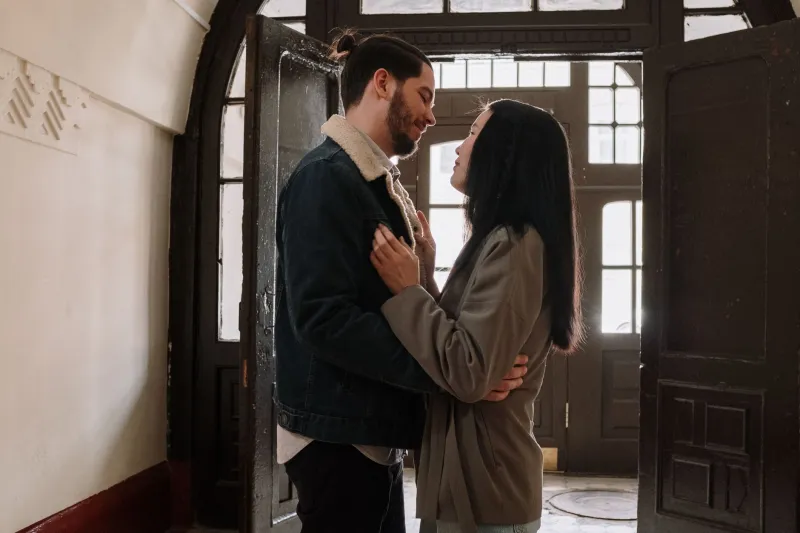
Paper Man is full of doorways. Characters stand in them, linger in them, and use them to avoid fully entering the room. The doorway is not just a staging choice. It is a way of being in the world: close enough to be tempted, far enough away to escape.
The prompt: Where in your creative life are you standing in the doorway? What project are you keeping at arm's length because committing to it would mean admitting you care? Write down the thing you keep circling. Then write one small action that would move you from the hall into the room. Not a life overhaul. One step.
5. What Would It Take to Cross the Room?
The awkward hug is the final question. It is not a graceful moment. It is a reach, a flinch, and a decision. Someone has to cross the room first. Someone has to risk being clumsy. The film does not pretend that is easy. It just shows that it is possible.
The prompt: What is the creative equivalent of crossing the room for you? Is it sending the email? Showing the pages to a friend? Finishing the draft that has been sitting at 80 percent for a year? Name the room you are in and the person or project on the other side. Then decide whether you are willing to be awkward to get there.
Paper Man does not answer these questions. It just leaves them on the table like a manuscript you can pick up or ignore. The film is not a worksheet. It is a mirror. And if you are a person who makes things, a mirror is sometimes the most useful tool in the room.