Reach, Flinch, Repeat: The Push-and-Pull of Personal Space in Paper Man
Paper Man is full of talking. Characters explain, deflect, confess, and joke their way through scenes. But if you watch the film with the sound off, you can still follow the emotional story. That is because the movie's real language is not in the dialogue. It is in the distance between bodies.
This is a craft piece, so let us get specific. Paper Man uses blocking, framing, and physical performance to map the personal space between Richard, Abby, Claire, and Captain Excellent. Who stands in the doorway. Who sits at the far end of the table. Who reaches first. Who flinches. Who stays in the frame and who gets pushed to the edge of it. The film's emotional architecture is built out of those choices, and the most important one is the awkward hug—the moment when the movie's whole thesis about touch and distance finally lands.
The Doorway Is a Character
Paper Man loves a doorway. Characters linger in them, lean against them, and use them as a place to deliver news they do not want to deliver. The doorway is a perfect blocking tool because it is a threshold in both senses: physical and emotional. You are inside or outside. You are welcome or you are interrupting. You are close enough to talk, but not close enough to touch.
Watch how often the camera keeps one character in the hall while another stays in the room. The frame does not just show two people. It shows two zones. The person in the doorway has an exit. The person in the room has no easy way out. That spatial arrangement does a lot of work without a single line of dialogue explaining who has the power in the scene.
Blocking as Emotional Weather
Blocking is the art of where people stand, and Paper Man uses it like weather. Sometimes characters are clustered around a kitchen counter, and the scene feels warm and crowded. Sometimes they are on opposite sides of a room, and the empty space between them feels like a third character. The film is not afraid of that space. It lets it sit there.
A good example is the way Richard and Abby often occupy the same room without sharing the same plane. One is seated, one is standing. One is near a window, one is near a door. The camera does not always put them in a tidy two-shot. It often favors a frame that keeps a little distance between them, even when they are talking about something intimate. That distance is not a mistake. It is the point. These are two people who are trying to connect without quite knowing the choreography.
The Awkward Hug as Thesis
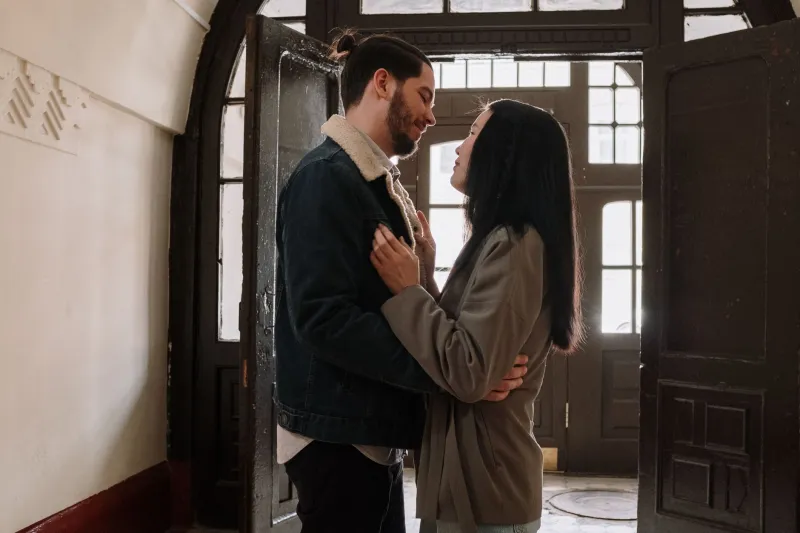
The hug is the whole movie in one gesture. It is not a graceful embrace. It is the kind of hug where one person reaches and the other person has to decide whether to receive it. There is a hitch in the middle. A hand lands somewhere uncertain. A shoulder does not quite soften. The camera does not swoon. It just stays there and lets the awkwardness be awkward.
That is why the moment matters. Paper Man is not interested in the fantasy of perfect connection. It is interested in the reality of trying. The awkward hug is a physical performance of that idea: two people who want to be close, who are not naturally good at being close, and who do it anyway. The reach is the bravery. The flinch is the history. The hug is the attempt.
What Changes When Someone Crosses the Room
Paper Man is careful about movement. When a character crosses a room, it means something. The film does not waste that action. A few steps can be a confession. A character who has spent the whole scene near the door finally sits down at the table, and the temperature of the scene changes. A character who has been keeping a careful distance suddenly leans in, and the frame has to adjust.
The camera often respects that movement by holding the shot a little longer or by shifting the composition to include both bodies in a new way. It is subtle, but it is deliberate. The film is teaching you to read space. By the time you get to the big emotional moments, you already know the grammar. You know what it means when someone stops hovering and finally commits to the room.
Why It Still Works
Plenty of indie films are talky. Plenty of them are emotionally raw. What makes Paper Man feel crafted rather than merely performed is the way it trusts physical space to carry meaning. The blocking is not decorative. The framing is not accidental. The awkward hug is not a quirky beat. They are all part of the same system.
Seventeen years after its release, that system still holds up. You can rewatch Paper Man and find new tension in a doorway, new tenderness in a half-step forward, new heartbreak in a hand that does not quite land. The film's dialogue is good. But its real voice is in the reach, the flinch, and the repeat.